Matching Learning System to Change Maturity
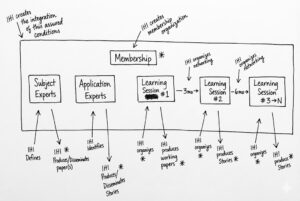
Over the last 20 years, the Breakthrough Series Collaborative structure of learning sessions and action periods has been adopted to pursue improvement worldwide. The structure feels practical, and people find working together with others rewarding.
So when a BTS-style effort concluded without achieving results, leaders asked: Is the Breakthrough Series Collaborative no longer effective? Is it time for something new?
What We Learned
A retrospective evaluation of a dozen collaboratives revealed that none achieved their aims. But the lesson wasn’t that the method had failed. The Breakthrough Series Collaborative remains a powerful learning system—when it’s applied to problems it’s designed for.
The BTS collaborative is a learning system for spread. An expert group works with an improvement advisor to create a change package of known changes that produce results. They draft aims, a family of measures, and a change theory captured in a driver diagram with change ideas. Teams are invited to use measurement and PDSA testing to experiment locally, successfully implement in a pilot unit, and replicate that learning to spread to other units.
When there’s a clear improvement opportunity accompanied by a change package that gets results, the BTS is an excellent learning system for spread.
But what if you don’t have a change package that gets results? Then a BTS collaborative is not the best method.
The Spectrum of Change Maturity
Different stages of change maturity require different learning systems. Here are the typical stages that lead up to a change package ready for spread.
Change Theory Development: Many times we don’t know what changes result in improvement. Start by framing “what good looks like” to direct your focus. Review the literature for peer-reviewed papers related to the topic. Look for people and organizations that have shared their work in conference presentations and posters. Reach out to your network and ask who’s working on the topic. Invite people to informational meetings to learn. Use the Model for Improvement to benchmark best practices. Study the information gathered and consolidate your learning into a prototype change package to test. Typically an individual or small team leads this work in a 90-day learning cycle. The output is a draft change package.
Develop a Prototype: Use PDSA to trial individual ideas and gather baseline data. Start with the smallest scalable unit that includes all the elements needed to test the changes—surgery cases, a room, or a unit. The intent is to test the change package, refine the changes and measures, achieve results, and increase your confidence in what works. Typically one to three teams participate in a series of small-scale tests with the intent of refining the changes and measures and building confidence in a change package that can be tested more broadly. Prototyping can take six to twelve months. The output is an updated change package with learning and results on a small scale.
Pilot Group: Developing the prototype change package is powerful learning, but now you need to introduce the change under different conditions. Testing the changes in several units and in different organizations, while sharing learning across them, will validate changes and measures and provide input to refine the change package for documentation and spread. A pilot is a collaboration with three to a dozen or more sites. There is confidence in the change package, but the intent is to increase belief it works across various conditions and adapt it for broader spread. A pilot can last twelve to eighteen months. The output is an updated change package, learning and results under a range of conditions, and belief that the change package is ready for spread.
Breakthrough Series Collaboratives: Once a change package has been shown to get results under different conditions and there are clear change ideas and a family of measures, you have the inputs to commission and execute a BTS collaborative with 12 to as many as 100 sites to implement and spread the changes and achieve results at scale. The outcome is testing and implementation across sites and organizations with local and system-wide results.
Learning Health Networks: LHNs are continuous improvement systems that bring together patients, families, clinicians, and researchers to improve outcomes for specific conditions or populations over time. Evolving from the BTS Collaborative approach, LHNs extend the model beyond fixed project periods to create ongoing cycles of learning and improvement. Participants share and test change ideas, use common data registries to track progress, and apply an “all teach, all learn” philosophy to accelerate discovery, spread effective practices, and integrate research and improvement in real-world care. LHNs develop change packages and spread results, publish new methods and knowledge, and produce research.
Essential Factors Throughout the Journey
Several factors are important at every stage of change package maturity.
First, blend expertise in Improvement Science with subject matter expertise in the topic. Both are essential.
Second, be disciplined in your design and execution, including documentation. At minimum, this provides rigor to your improvement work. It also supports sharing your work in posters, presentations, and peer-reviewed publications.
Third, don’t rush. Select the stage of maturity that best matches your degree of belief in the change. Make sure you have the right inputs and work toward the output that will become the input for the next stage.
Finally, go slow to go fast. The step-wise approach builds will and confidence and reduces rework, speeding progress over time.
Testing This Framework
Look at improvement efforts in your organization that you intended to spread. Which stage of maturity best matches your changes?
If you’re convening teams to spread changes that haven’t been tested and refined, you’re setting them up to struggle. If you’re running endless pilots because you haven’t built confidence in your change package, you’re stuck.
Match your learning system to your change maturity. The right method at the right time accelerates progress. The wrong method, no matter how well-intentioned, wastes everyone’s effort.
David M. Williams, Ph.D. works with leaders and improvement teams to learn and apply Improvement Science to achieve results and adopt quality as a strategy. He is coauthor of Quality as an Organizational Strategy and The QOS Field Guide.